
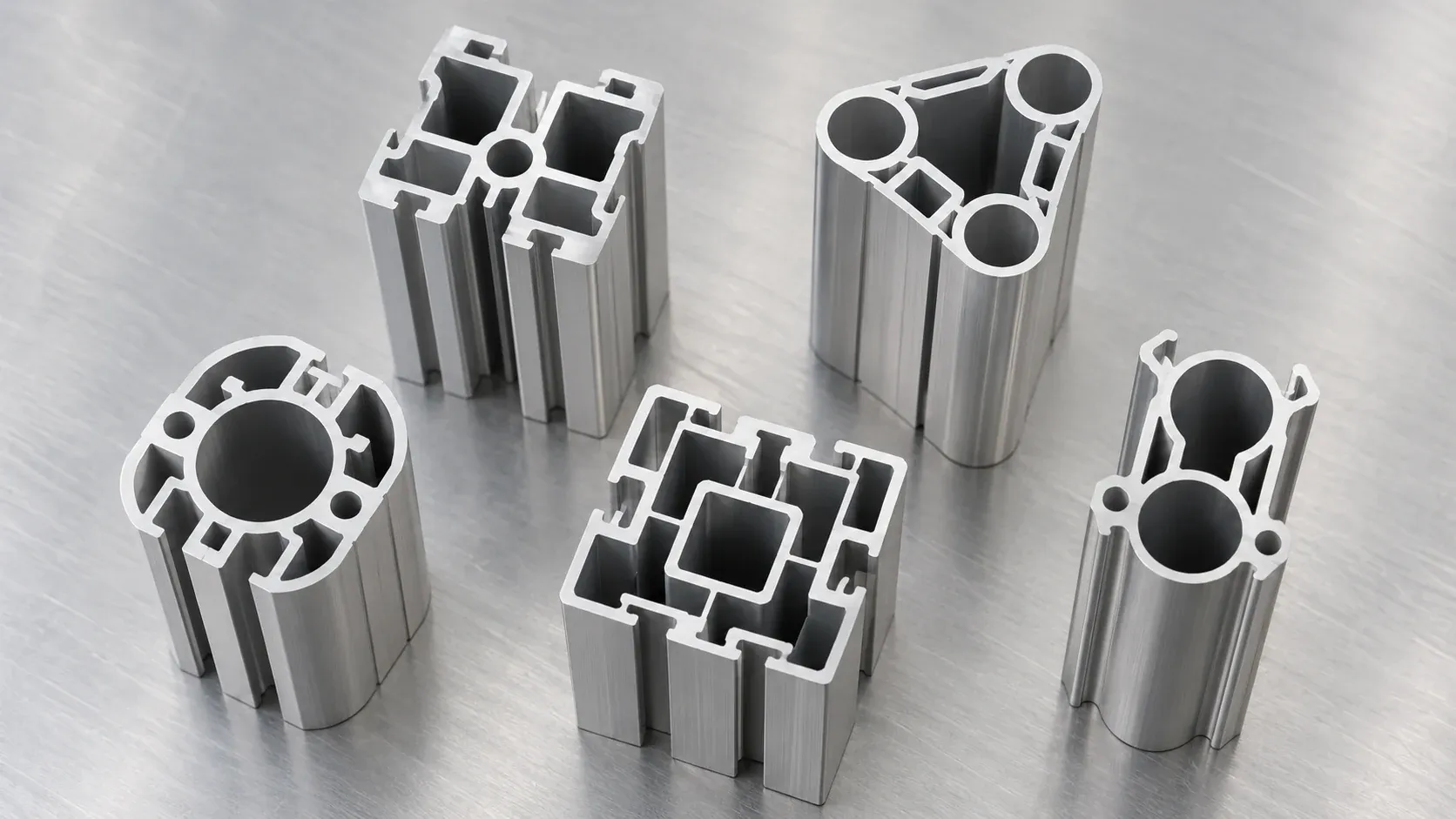
How does a custom extrusion project run?
It starts with your part and ends with series supply. There are five steps.
- Drawing and requirements. You send the cross-section drawing, alloy and temper preference, surface requirement, annual volume and profile length.
- Design-for-manufacture feedback. Wall thicknesses, closed voids and corner radii are reviewed for extrusion. Where it helps, we propose changes to the drawing.
- Die. A die is made for the approved section. Our die archive holds 3000+ dies.
- Sample approval. You check the first sample against the drawing for dimensions and surface and release it.
- Series production and shipment. Series runs follow the approved sample. Delivery terms are agreed in writing for each order.
What information do we need to quote?
| Input | Why it matters |
|---|---|
| Cross-section drawing (PDF, DWG, DXF, STEP) | Die design and weight per metre |
| Alloy and temper | Strength, surface and machinability |
| Surface (mill finish or electrostatic powder coating) | Line planning, colour and gloss requirement |
| Annual volume and batch size | Production planning and die life |
| Profile length | Press run-out and packing plan |
| Tolerance requirement | To agree the applicable tolerance standard (for example EN 755-9 or EN 12020-2) |
Which alloy and temper should you specify?
6xxx (Al-Mg-Si) alloys dominate extrusion. The table below describes the general character of each family. It is not a stock list or a commitment; alloy and temper for your part are agreed during quotation.
| Alloy | General character | Typical use |
|---|---|---|
| 6060 | Suits thin-walled, complex sections; good surface | Building, furniture, general-purpose profiles |
| 6063 | Architectural alloy; surface quality and formability | Windows, doors, façades, decorative profiles |
| 6005 | Higher strength than 6060 and 6063 | Structural members |
| 6082 | The high-strength alloy of this group | Load-bearing structural parts |
Temper describes the heat condition after extrusion. In T5 the profile is cooled at the press exit and artificially aged; T6 adds solution heat treatment. More in What is aluminium extrusion?
Which tolerances apply?
The applicable tolerance standard (for example EN 755-9 or EN 12020-2) is agreed in the quotation. The permitted deviation varies with section, alloy and size; numerical values for the critical dimensions on your drawing are agreed in the quotation. See Quality and sustainability for our quality approach.
Can you deliver powder-coated profiles?
Yes. The capacity of our electrostatic powder coating line is 450 tonnes per month. Colour and gloss are specified per order, and mill-finish profiles can be supplied as well. For the presses and the line see Facility and capacity.
Not ready with a drawing?
Start from standard sections such as tube, box, angle, channel, tee and flat bar: Products and standard profiles. For extrusion billet: Aluminium billet supply. We export to Switzerland, Poland, Germany and France.
Frequently asked questions
What do you need to start a custom die?
A technical drawing of the cross-section (PDF, DWG, DXF or STEP), the alloy and surface finish you expect, the estimated annual volume and the profile length. Anything missing is clarified together during quotation.
What is the minimum order quantity?
300 kg per profile.
Who pays for the die and who owns it?
For orders of 20 tonnes or more, Solid Group Metal covers the die cost. For smaller orders the die cost is charged to the customer. Ownership terms are stated in the written quotation.
How long until the first sample?
Lead time depends on the complexity of the section and the die plan. The expected sample date is given with the quotation.
Related guides
- Designing a profile for extrusion: practical DFM rules
Design for manufacture guidance for aluminium extrusions: uniform wall thickness, hollows and tongues, corner radii and the circumscribing circle.
- Extrusion tolerances explained: EN 755-9 and EN 12020-2
What the European standards EN 755-9 and EN 12020-2 cover for aluminium profile dimensions and form, and how to specify tolerances without adding cost.
Last updated: